
Advanced Diagnostic Technology
CBCT 3D Imaging
A single scan that gives us a complete three-dimensional map of your jaw, so every implant is placed with precision, not guesswork.
Reviewed by our dentists, Updated April 2026
What is CBCT imaging?
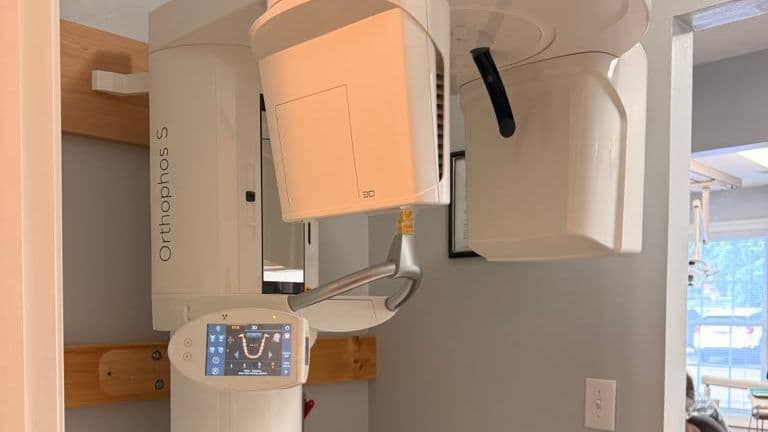
CBCT stands for cone beam computed tomography. It's a specialized type of dental X-ray that produces detailed three-dimensional images of your teeth, jawbone, nerve pathways, and surrounding structures, all in a single, quick scan. Unlike traditional two-dimensional X-rays that show a flat picture, CBCT gives Dr. Perry the ability to rotate, zoom, and examine your anatomy from every angle. At Roanoke Dental Center, we use this technology as a standard part of implant planning because it eliminates guesswork and dramatically improves outcomes.
Why it matters for dental implants
Placing a dental implant is a precise procedure. The titanium post needs to go into bone that is dense enough to support it, at an angle that avoids nerves and sinuses, and in a position that allows a natural-looking crown on top. A traditional X-ray can't show all of that. CBCT imaging provides the complete picture:
- Bone density and volume, We see exactly how much bone you have and whether grafting is needed before placement.
- Nerve location, The inferior alveolar nerve runs through the lower jaw. CBCT mapping ensures the implant is placed safely away from it.
- Sinus proximity, For upper jaw implants, we measure the distance to the sinus floor and plan accordingly.
- Adjacent tooth roots, We verify there's adequate space between the implant site and neighboring teeth.
- Surgical guide fabrication, The 3D data is used to create custom surgical guides that direct implant placement with millimeter accuracy.
What the scan is like
The CBCT scan itself is quick and completely comfortable. You stand or sit while the scanner rotates around your head, the entire process takes about twenty to forty seconds. There's no claustrophobia like an MRI, no loud noise, and no discomfort. The images are available immediately, so Dr. Perry can review them with you during the same appointment. Many patients at our Roanoke, VA office are surprised at how fast and simple it is.
Radiation safety
A common question we hear from Roanoke Valley families is whether the scan is safe. CBCT uses significantly less radiation than a medical CT scan, typically comparable to a set of traditional dental X-rays or the amount of background radiation you'd receive in a few days of normal life. We follow the ALARA principle (as low as reasonably achievable), meaning we only take CBCT scans when the diagnostic benefit is clear. For implant cases, the information gained far outweighs the minimal exposure.
Beyond implants: other uses
While implant planning is the most common reason we use CBCT at Roanoke Dental Center, the technology is also invaluable for diagnosing impacted teeth, evaluating jaw joint disorders, identifying infections or cysts that don't show on standard X-rays, and planning complex extractions. It's one of those investments in technology that benefits nearly every area of patient care.
Better imaging, better results
The difference between placing an implant with a 2D X-ray and placing one with full 3D imaging is the difference between a good guess and a precise plan. Dr. Perry uses CBCT data to plan every single tooth implant, multi-tooth case, and All-on-4 full-arch restoration at our practice. It's one of the reasons our patients in Cave Spring, Harrisonburg, and across Roanoke County can feel confident that their treatment is built on the best available information. Learn more about the full implant procedure, explore our restorative services, or return to the main dental implants page.
Frequently Asked Questions
Is a CBCT scan safe?+
Yes. A CBCT scan uses significantly less radiation than a medical CT scan, typically comparable to a standard set of dental X-rays. We follow the ALARA principle and only take CBCT scans when the diagnostic benefit is clear, which it always is for implant planning.
How long does the CBCT scan take?+
The scan itself takes about twenty to forty seconds. You stand or sit while the scanner rotates around your head, no claustrophobia, no loud noise, no discomfort. Many patients at our Cave Spring offices are surprised at how quick and simple it is.
Does every implant patient need a CBCT scan?+
At Roanoke Dental Center, we use CBCT imaging as a standard part of implant planning because it gives Dr. Perry the detailed 3D information needed to place implants safely and precisely. It's one of the tools that helps us achieve high success rates.
What does a CBCT scan show that a regular X-ray doesn't?+
A traditional X-ray gives a flat, two-dimensional image. CBCT produces a full three-dimensional map of your jawbone, nerve pathways, sinus position, and surrounding structures. This lets Dr. Perry measure bone density, identify the safest implant angle, and avoid critical anatomy.
Is CBCT imaging used for anything besides implants?+
Yes. We also use it to evaluate impacted teeth, diagnose jaw joint disorders, identify infections or cysts that don't show on standard X-rays, and plan complex extractions. Roanoke Valley patients benefit from having this advanced technology available right here in Cave Spring.
Will my insurance cover a CBCT scan?+
Many dental insurance plans cover CBCT imaging when it's medically necessary, and for implant planning, it typically qualifies. We'll verify your benefits and let you know what to expect before the scan is taken. No surprise charges.
★ When You're Ready
Come see for yourself.
Take your time choosing the office that fits.
Pick the Cave Spring office that's closer to you. Appointment scheduling is open 24/7 by phone or online, clinical visits are Monday-Friday, 8 AM to 5 PM at both offices.
Visit Electric Rd
2660 Electric Rd Suite A
Visit Brambleton Ave
4907 Brambleton Ave
Or call the front desk